Thursday, April 12, 2007
On this day:

Not Going to a Go-Go

Listening to the sublime, 'The Frog and the Princess' from Grace Jones's 1985 'Slave to the Rhythm' album the other day, I started thinking about Go-Go, the Washington DC take on funk that was briefly fashionable in 85/86 (a number of renowned Go-Go musicians played on the Jones LP). Looking at the entry for Go-Go on Wikipedia, I was surprised to learn not only that this style of music is still being made, but that it is a source of tension between the black community and law enforcement agents and municipal officials in the US capital and surrounds. In March of this year, so the story goes, nine Go-Go clubs in Prince George's County, Maryland, were shut down because of the number of police calls they were generating.
Earlier this decade, Go-Go also spawned a stripped down sub-genre called Bounce Beat. Examples of both contemporary Go-Go and Bounce Beat can be heard via the Washington Post website. And one advantage of downloading these files into Quick Time is you can play around with the speed and pitch control, giving Little Miss Muffit by TimesUp a 1992 'Ardkore style makeover in the process.

Labels: , ,

Sunday, April 08, 2007
On this day:

Spezialismus

You can tell something about a place from the specialty shops it attracts. In Munich the other week I was kinda surprised, but in an 'oh yeah, it makes perfect sense' kinda way to see a high street shop selling fire extinguishers.
And what better proof that the English are 'a nation of shopkeepers' than a shop selling cash registers? I used to pass one on my way home every day when I lived in Nottingham. Any other examples anyone?

Labels:

Saturday, February 17, 2007
On this day:

One-line travel reviews

Tourist boards around the world try and sum up the charms of their city/country/region in one pithy line ('Glasgow's miles better', etc). But two can play at that game. How about these for one-line travel reviews from a friend in SE Asia:
Banda Aceh: an island full of religious nut-jobs.
KL? Full of pot bellied expats and transexual hookers...

Labels:

Sunday, January 07, 2007
On this day:

Cardiff's twin selves

Spent an enjoyable couple of days back home in Wales between Xmas and the New Year. One of the highlights was an afternoon recording voice parts for some new episodes of Grammarman comic, the brainchild of my school friend, Brian Boyd. Brian, who lives in Bangkok these days, created Grammarman and his retinue of friends and enemies as a fun way of teaching English to non-native speakers. I played several parts in the latest episodes, which are due online shortly, including the villain Luther Lexis. Other parts were taken by several old friends and acquaintances, with another old mate, Jules Davies, providing the sound engineering expertise. That we had a blast I hope will be apparent to all listeners.
Later that evening we all headed down to the centre of Cardiff. Stepping out of the taxi on Mill Lane, I didn't recognise where we were for a couple of seconds, so greatly has the street changed in the last few years. For years, virtually the only business premises on Mill Lane was a sex shop. Today, that Private Shop remains (owner David Sullivan won't give up his freehold), but it is surrounded by a dozen or more bars, pubs and restaurants. We ensconced ourselves in the comfortable upstairs corner of the Iota Bar, later heading to a Hippo Club Reunion Night at Wish (Hippo's was a popular haunt in the late 80s/early 90s) for a selection of classic house and trance fed to the floor by DJs including John the Dentist.
Cardiff's status as one of the UK's coolest cities (Dr. Who, Millennium Stadium, the bay, etc) is a far cry from the city I knew and grew up next to. Fifteen years ago, there was one half-decent record shop (Spillers), one goodish club (Tom Tom's), the occasional quality band at the Students' Union, and that was about it.
Although rougher round the edges and significantly less fashionable, for a small town boy like me, Cardiff was still the big city and a trip there was a day to be savoured. One of the small pleasures of an otherwise hellish one hour journey on the X51 bus was seeing the names of Cardiff's twin cities at Culverhouse Cross (home to the HTV Wales studios and little else during my teenage years, rather than the retail behemoth of today). Those places - Nantes in France, Stuttgart in West Germany, Xiamen in China, and Voroshilovgrad in the USSR - seemed impossibly glamourous and remote. Having visited Stuttgart twice, I have to say that it is one of my favourite German cities (the place where the grape meets the grain); Nantes and Luhansk (as Voroshilovgrad once more became in 1990) remain mere dots on the map, but a few months back I was lucky enough to get the opportunity to visit Xiamen.
Located in Fujian province in sub-tropical southeast China, the city's climate certainly doesn't compare to that of southeast Wales (even if you can also spot the occasional palm tree in Cardiff and environs). Like Cardiff, however, Xiamen has a fabulous harbour. A trip on the ferry over to Gulangyu Islet is well worth the effort. The islet houses 20,000 residents, a couple of museums, some beautiful small beaches, a traditional Chinese garden and a wealth of colonial architecture (In 1541, Xiamen, then known as Amoy, became the first port in China to trade with Europeans, giving the English language the words tea and ketchup in due course. Later the city was one of five ports opened up to foreign trade by 1842's Treaty of Nanjing). Gulangyu also has a very large statue of Zhen Chenggong ('Koxinga'), the general who captured Taiwan from the Dutch in 1662.
Surprisingly, given Xiamen's proximity to Taiwan, and the noted antipathy between the PRC and the Republic of China, I saw no signs in the city or its surrounds of a large military presence. Likely the sabre-rattling in which the 'Communist' government occasionally indulges is simply that: sabre-rattling.
Like its Welsh twin, Xiamen is a dynamic city (in 1980 it became one of the first places in China to be declared a Special Economic Zone). There are few signs of the city's Cardiff links, but I did spot one in the Hollywood Snack Bar at the Holiday Inn Crowne Plaza Hotel Harbourview: A Welsh flag on the wall, signed by visitors from the principality. For a photo of this and other images of Xiamen, click here.

Labels:

Wednesday, November 22, 2006
On this day:

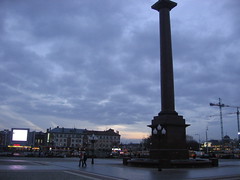
Kaliningrad: skies and limits


Big sky, Kaliningrad
Originally uploaded by MonkeyGone2.
I was fortunate enough to be invited to visit the Russian exclave of Kaliningrad last week. The collapse of the USSR was particularly troublesome for the province, which, found itself cut off from 'big Russia' in 1992. Sandwiched between Lithuania and Poland, Kaliningrad, which had been a heavily militarized region that was closed to foreigners during the Soviet era, suffered extreme economic hardship as many businesses went to the wall. Serious outbreaks of HIV/AIDS and TB and the sense that Kaliningrad had been forgotten added to the gloom.
Today, Russia's 'extreme west' remains something of an enigma, an anachronism and (for the EU) a problem, but it is also beginning to be a place of opportunity. Kaliningrad's status as a Special Economic Zone (SEZ) with more favourable tax and investment rules than other parts of Russia, has led to many manufacturing businesses shifting production there. The BBC's Laura Sheeter provides some details here.
Kaliningrad airport may be more reminiscent of those serving small communities in Finland and Sweden than a major international hub (I arrived by Fokker twin-prop from Copenhagen), but a trip to Victory Square in the centre of the capital indicates the revival of the province's fortunes. As well as the cranes on the skyline (see photo), a new shopping centre has sprung up and a new cathedral - Christ the Saviour - was completed in September.
Aside from Victory Square, Kaliningrad's other major tourist attraction is the Koenigsberger Dom, a 14th century cathedral that houses the tomb of Immanuel Kant. The celebrated philosopher spent almost his entire life in the East Prussian city of Koenigsberg. When the Red Army rolled into the ruins of this easternmost German outpost in 1945, it set about expelling the population. Over the next 40-odd years, many physical reminders of Kaliningrad's German heritage were also removed. Thankfully many still remain (the architecture is a curious mix of modern international, Soviet and Prussian).
One of the oldest buildings in the city, a former German fort, is now a restaurant. Both food (fish, red caviar and eel) and vodka were very good. According to my host, Kaliningrad is one of three regions in Russia where the vodka is particularly notable (the others being Baikal/Irkutsk and Vladivostock). He was somewhat disparaging of the vodka in Moscow and St. Petersburg.
Driving two hours east to the town of Neman I was surprised at how good the road was. Having found the roads of western Poland very hard going during a visit four years ago, I was expecting those in Kaliningrad to be as bad, if not worse. In fact, once you get past the checkpoint set up to prevent Chechen terror attacks on the city of Kaliningrad, the road surface of the main highway is fine (on a par with eastern Germany). The road even turns into a dual carriageway in places.
The roads in Neman were a little more rough and ready, but the town of 12,000 people, which had an unemployment rate of 97% in the late 1990s, is back on its feet now, with a recently built hotel and bank, and a multimillion dollar investment program at Neman Pulp and Paper Mill, the town's main employer. The mill was brought out of bankruptcy at the turn of the decade by a company from St. Petersburg.
Neman backs on to the River Neman, the border with Lithuania. While walking close to the river an alarm sounded. "That means that someone has crossed the border illegally", my guide and interpreter explained. Although smuggling still goes on, the smugglers face a much tougher task since the river became the frontier with the EU, as Laura Sheeter notes.
Crossing the border is also a problem for legitimate trade and travel, however. One local businessman explained to me that it once took him two hours to get into Lithuania via the road bridge at Sovetsk (10 km from Neman). Crossing the land border between Russia and Finland takes 15 minutes. Shipments of goods can be held up at customs for one to two days. A transit tax applicable to some shipments passing through Lithuania can also offset the benefits of producing in the SEZ. This additional tax burden is one reason why the dream of turning Kaliningrad into 'the Hong Kong of Europe' will not be easy to realize. But for the Kaliningraders with new jobs, cars, shops and restaurants to appreciate, life is already a whole lot better now than it was in the 90s.

For a selection of photos from Kaliningrad Oblast, click here.

Labels:

Sunday, September 24, 2006
On this day:

Chance encounters in rural Sweden

12:49 am: Waiting for the last bus to Karlstad at Kristinehamn station when a tattooed guy in his early 20s races up on a mountain bike. He begins a frantic explanation in Swedish, before I interrupt in English with, 'I'm sorry I don't speak Swedish." The young man is surprised but continues in English: "Have you seen a girl with blonde hair, she might have an upset face?" I say "no, sorry I haven't. "I've had a row with my girlfriend and she walked off," he explains. "So she hasn't been here? That's good."
After reflecting a moment, he asks, "What are you doing here?" "Waiting for the bus to Karlstad" "Yes, but what are you doing in Sweden?" "I am a journalist, I am here for work." "Really? That's cool. I am a sound engineer." "What, like a studio engineer?" "Yeah, I have been doing a show with a band tonight." "Wow." "Well, I'd better keep looking for my girlfriend." "Good luck. If I see her, I'll tell her you're looking for her." "Ok, thanks, have a good time in Sweden."
1:07 am: The bus arrives, it is two minutes late. After boarding, the driver begins saying something in Swedish. Again I apologize for not speaking the language. Switching to English, he repeats his apology for being a couple of minutes late: "There is a problem with the back door."
Some minutes into the journey, after the only other passenger has got off, the driver asks: "Are you British or American?" "British", says I. "I am going to England tomorrow. To Frimley, in the South." "Oh yes, Frimley. In Surrey.""Do you know the Cheddows?" "I'm sorry?" "The Cheddows? Hank Marvin?" "Oh, The Shadows, yes, yes."
"I go to England every year at this time - to Shadow Mania," the driver proudly explains. "Aha." A pause. My trump card. "I used to know a guy who played in a band with Jet Harris." "Sorry, I didn't hear, the engine is very noisy." I stand and say louder, "I used to know a guy who played in a band with Jet Harris." "Oh, yes, ok, Jet Harris."
After 20 minutes of silence we reach Karlstad. We pull into the station. 'Goodnight," says the driver. "Tak, goodbye, enjoy Shadow Mania," I respond. He grins and drives off into the bus depot as I walk the few hundred metres to my hotel.

Labels:

Sunday, July 23, 2006
On this day:

Time out in London and Guildford

Thursday evening: Arrive at London Waterloo on the Eurostar from Brussels. Take the 188 bus to Bricklayer's Arms. 'Check in' to my mate Steve's apartment in the Jam Factory, a housing and office complex on the site of the former Hartley's Jam factory in Bermondsey. Cross to the other side of Tower Bridge Road for dinner in The Hartley, an award winning gastropub. I have a prawn cocktail followed by a lamb and parmesan burger with a side serving of old English mustard. The grub is nice but not spectacular, the venue trendy, but not achingly so. Two criticisms: no air con (a complaint that applies to 90% of venues in London) and a rather bland selection of beers (Boddingtons is the only ale and there are no artisanal brews).

Friday: Stroll from 'Sobo' - as estate agents and style mags have taken to calling the gentrified, bohemian edge of hard-as-nails Bermondsey (the acronym stands for 'South of Borough', don't you know?) - via the remnants of the antiques market on Long Lane to Borough Market. Walking round the place that launched the farmer's market revival on a beautiful sunny morning is a lovely experience. Pick up some Red Leicester cheese straws, a Melton Mowbray pork pie and some freshly squeezed orange juice before popping into the Monmouth Coffee Company for an ice filtered Sumatran brew.
The market backs on to Southwark Cathedral, a charming early 12th century gothic building that contains the tomb of king Henry IV’s poet laureate John Gower.
Crossing the road and walking past Vinopolis, the remains of Winchester House and the replica of the Golden Hinde, I follow the Thames Path westward before crossing into North London via Southwark Bridge, taking in the view of Docklands, Tower Bridge, Swiss Re and St. Paul's.
Reaching the Millennium Bridge, I cross back over the river and take a detour round the third floor of Tate Modern. Surrealist films from the 1920s and the sculptures of Louise Bourgeois were the things that connected best on this visit - next time, who knows?
Continuing along the South Bank, I pause for some lunch at a cafe attached to the National Theatre. My arrival coincides with one of the events in the Watch This Space season - a performance by Moya (African-jazz-folk and roots rhythms from Swaziland). The sweet voices of the two female singers aid the digestion of a cheese sandwich washed down by a dandelion and burdock flavoured drink.
After lunch, I head over the Thames again via one of the Golden Jubilee Footbridges and make for Fitzrovia, where I have a five o'clock rendezvous with some old friends. Passing through Trafalgar Square, I pay the National Portrait Gallery a brief visit. A BP sponsored portrait competition is on display. Works by Gregory Cumins, Jon Jones and Andrew Hilling stand out.
I head through Leicester Square and China Town, followed by a spot of browsing on Oxford Street. Feeling peckish I recall a fish and chip shop close to Pollock's Toy Museum on Scala Street. The food tastes good, although it is just too hot to really appreciate battered cod and chips.
Meeting my mates on Mortimer Street, we have a few pints outside the Crown and Sceptre on Great Titchfield Street, an old after work haunt and one of the nicest pubs in the area, especially when the sun is shining.
I'm staying overnight in Guildford, so my friend Nick and I decamp to the Surrey commuter town. It's a surprising place: "A bit of a Jekyll and Hyde town" as one of Nick's pals put it. By day, a well-heeled piece of archetypal Middle England, by night, a pissed-up regular on security cam documentary, 'Booze Britain'. Appropriately, while sitting outside the Royal Oak pub I take the opportunity to sup a Cheeky Vimto for the first time. Known as a favourite of Charlotte Church, this combination of port and the Vodka-based alcopop Blue Wkd does indeed taste like the fruit-flavoured drink Vimto, long a favourite of children in the north of England.
Guildford is also popular location with film and TV location scouts. The town's appearances range from 'The Omen' (the final scene takes place at Guildford Cathedral) to 'The Bill' (the plodding feet of the famous end title sequence were filmed on Guildford's cobbled High Street, hard to imagine given the steepness of the gradient - it always looked flat to me on the telly).

Saturday: Heading back into London around midday I meet up with another old pal at the Duke's Head in Putney. This charming riverside pub does a very tasty Ploughman's Lunch and still charges only 30p for a pint of lime and soda. Bargain.
Check in to the Portobello Hotel. I'm offered a discount as the lift is broken. My room is small but very comfortable, with a large Bang & Olufsen TV. I wander down Portobello Road and have a drink in The Duke of Wellington (aka Finch's), an old stomping ground from the days when I worked at the Music & Video Exchange on Notting Hill Gate. Later I decide to take advantage of the evening's membership of the Cobden Club offered to all guests of the Portobello Hotel. The lack of air conditioning in this former working men's club is a drag on such an oppressively humid evening. But the decor is grand and the bourbon-based cocktails I sample (including a house special 'Grape Crush') are, as they say in Ireland, grand too. The upstairs disco (tedious rare groove and men with goldie lookin' chains round their necks) and reading room (with oohh, maybe 10 books!) are not so grand.

Sunday: After an excellent continental breakfast I check out and head into Hyde Park. It's still very warm and very cloudy, so I take a break in a deckchair (£1.50, pay when asked) next to the Round Pond. I carry on towards one of my favourite London spaces, the Serpentine Gallery. Thomas Demand is the featured artist. I was previously unfamiliar with his work (photographs of domestic and office interiors that upon closer inspection reveal themselves to be photos of sculptures made from paper and cardboard) and am impressed. Demand has also decked the gallery out in wallpaper with an ivy motif that he designed in collaboration with a manufacturer that uses a traditional block printing motif.
Demand's wallpaper also finds its way into this summer's Serpentine Gallery Pavilion, a bizarre clear plastic and white fabric dome created by architect Rem Koolhaas and structural designer Cecil Balmond. This temporary building is the sixth to be erected outside the gallery since the pavilion concept, a scheme that enables some of the world's leading architects to build a structure in Britain for the first time, was launched in 2000.
After enjoying a '99 Flake from an ice-cream stand, I round off the weekend by buying some books ("A short history of tractors in Ukrainian", Jared Diamond's "Collapse" and, for my fiancee, Alison Weir's "Isabella") and DVDs ('Peep Show - series one', 'The Machinist', 'Glengarry Glen Ross' (only £2.99!) and some episodes from 'Minder' (series four, natch)). Having shopped, I drop to the ground in Soho Square, enjoying sandwiches (Wensleydale and caramelised carrot chutney) and crisps (salt and vinegar squares) from Marks & Spencer in the sunshine and the shadow of the British Board of Film Classification and the headquarters of the Football Association.

Labels:

Thursday, March 30, 2006
On this day:

Nanchang meets the West

Back in the saddle after a two-week blogging hiatus caused by a frantic trip through China (Beijing, Ningbo, Shanghai, Wuxi, Changshu, Nanchang, Guangzhou and Hong Kong in eight days). The country's pace of development continues to amaze, its pollution to apall (if you ever go to Changshu don't expect to see the other bank of the Yangtze).
The most interesting place on the itinerary (because the most provincial) was Nanchang, a small city (1.5 million-2 million people) that is the capital of Jiangxi province.
Nanchang is famous for the Tengwang Pavilion, one of the top three pagodas in the country, and the Bayi suspension bridge (over the Gan River) with its statues of a black and a white cat (erected in honour of Deng Xiaoping's famous statement that "it doesn't matter if it is a black cat or a white cat: if it catches mice it is a good cat.")
Today, Nanchang is also known for its baby trade. Our hotel was full of American couples and their adopted offspring. Although a little disconcerting to see at first, at least this baby trade is being properly monitored today: the adoptive parents are required to go through a number of bureaucratic hurdles. They also return to China to meet with other parents of Chinese babies and to ensure that their kids do not lose touch with their roots.
Another memorable feature of Nanchang is a full-size replica of the Arc de Triomphe at the Cinquantenaire in Brussels. This seems to be part of a new high-end housing estate called the European Resort. Whether it features any other notable European monuments, I cannot say.

Labels:

Tuesday, November 29, 2005
On this day:

Thanksgiving in Texas

Two items that caught my eye watching the local news in Dallas over the Thanksgiving weekend:
12 protestors were arrested outside the Bush family's ranch in Crawford. A new bye-law prevents anyone from protesting within seven miles of the property.
Some Texas cities asked residents frying Turkey to keep hold of the cooking oil. The authorities planned to collect the oil and recycle it into biodiesel.(A nice surprise, particularly as gasoline here is below $2 per gallon once again).

Labels:

Sunday, November 13, 2005
On this day:

The sounds of young Santiago


Blondie by day
Originally uploaded by MonkeyGone2.
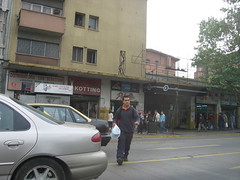
This photo shows the exterior of Santiago nightclub, Blondie (the awning with the 'B' logo that is remarkably similar to Henry van de Velde's design for the Belgian Railways). The Britney Spears and N'Sync special I attended there last month was quite an eye opener. I have never seen a club as busy on a Sunday night: there must have been 1,500 people inside.
Getting in was quite a hassle. The club opened about 45 minutes late and the security checks seemed to take forever, meaning that the place filled up slowly. The slightly decrepit building housed two dance floors: one with room for about 100 people where the DJ was spinning 80s synth pop (New Order, Soft Cell, etc) and a much larger main hall for 1,000 to 1,500 people, complete with video screens.
Here, the evening started with the Britney Spears Special, which bizarrely was a replay of a live concert taped off French cable channel, MCM. Later, once the floor was full, the DJs brought the crowd to a frenzy with a succession of N'Sync videos (including the one where they are N'Sync dolls come to life in a toy shop).
Chilean taste in music is a little quirky to say the least. The aren't many places where you can walk into the metro and see Queen's 'Fat Bottomed Girls' on a video screen. You can in Santiago. Equally, it is one of the few cities where you can still buy a badge celebrating 1980s hardcore punks Minor Threat with little difficulty.
Friends from Brazil and Colombia who accompanied me on the trip were surprised that they never heard Chilean music in any of the restaurants we visited, only music from other parts of Latin America. In Colombia and Brazil, local music is heard all the time, they explained.

Labels:

Friday, November 04, 2005
On this day:

Giratorio

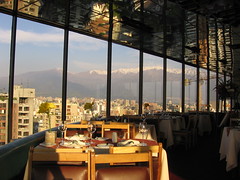
One of the highlights of my recent trip to Chile was dinner inside the Giratorio, Santiago's very own revolving restaurant. There's something very satisfying about watching a city go idly by as you tuck into your nosh. Back in the 90s I had something of a penchant for revolving restaurants, visiting two in Bratislava in one week. I reckon this is some kind of nostalgic impulse driven by the Kitten Kong episode of The Goodies, with its memorable scene involving London's Post Office Tower.
There is something very modernist about the whole revolving restaurant thing: a 60s/70s International Style fad that has just about survived into the 21st century. You can imagine Augusto Pinochet, fresh from one of his shopping trips to London, asking Santiago's city planners to come up with something that could replicate the GPO Tower dining experience. Bizarrely, my main course at the Giratorio was like a Chilean riff on fish'n'chips: battered conger eel and a fried egg and chips. Not bad actually. And the wine was, as you'd expect in Chile, excellent.
Unlike with some revolving restos I have visited, the Giratorio building itself does not move, instead the restaurant is on a kind of giant turntable inside a rectangular steel and glass structure. With mountains on all sides, the 90 minute 'journey' around Santiago is a picturesque and contemplative experience. Can the Muzak though please guys!
As far as I know, no-one has set a movie inside a revolving restaurant, but it would make a great backdrop to the passage of time in one location. You can imagine a film about Chile from the 1970s to the present day, with every scene taking place at a table in the Giratorio...The passing of the seasons, the journey from hope to despair and back again. So many possibilities...

Labels:

Sunday, October 30, 2005
On this day:

Cachaca 101

Sao Paulo bar/restaurant Universidade da Cachaca more than lives up to its name. With 420 different cachacas to choose from (more than 300 of them from Minas Gerais state, acknowledged by most Brazilians as the home of the finest examples of the drink), it can satisfy the most demanding of students. And for neophytes such as myself, the knowledgeable bar staff will happily design a program that takes you from the mildest to the strongest cachaca in four increasingly drunken steps. Passing this exam was a pleasure, although my memories of the graduation ceremony are a little hazy.

Labels:

Saturday, October 15, 2005
On this day:

The SPrawl

"After two days in Sao Paulo I now know why Brazilians like to party: the place is such hard work that you have to enjoy yourself when you can. Horrendous traffic jams, stinking pollution and a cityscape that is so indistinct that even local drivers cannot orientate themselves (one hill of mid-rise tower blocks looming over higgledy-piggledly shacks looking much like another). Caipirinhas and churrascarias are some compensation for this urban nightmare, but not enough for my taste. And, despite being a city of 20 million people (third largest in the world), Sao Paulo has precious few tourist attractions. Among them are the notorious love motels, where young couples can rent a room away from their parents for a couple of hours (and older lovers can do likewise). With fantastic names such as Alibi and Opium and kitsch themes (Ancient Egypt, Roman Empire), these temples of lust are one of the few SP sights that can alleviate the boredom and frustration of travelling around this enormous, unwieldy place.

Labels:

Sunday, September 25, 2005
On this day:

The Hollywood of the Carpathians

Putting your city's name in giant letters on a hillside worked for Hollywood, so why not for Brasov? Two years ago, the mayor of this multicultural city of 350,000 people in the heart of Transylvania (a mix of (mostly) ethnic Romanians, as well as Hungarians, Germans and gypsies), decided to put the theory to the test. Although a little smaller than the Hollywood sign, the letters B-R-A-S-O-V on the side of Mount Tampa certainly attract the attention of all visitors to the city. Brasov (pronounced Brash-ov) is already the centre of Romania's small but growing tourist industry, thanks to a charming medieval old town, picturesque countryside and the nearby Bran Castle which, despite its tenuous links to the historic Vlad Tepes (Vlad the Impaler), has been succesfully promoted as 'Dracula's Castle' to legions of foreign visitors.
Mentioning the Brasov sign to my driver, George, on the way to Bran Castle, he lets out an exasperated sigh. "Our mayor spends money on this sign, instead of on our schools." A self-confessed patriot, George is fed up with his country. And, at 37, he he wonders whether anything will change in the '30 years or so' he has left to live. As we pass gypsies in wooden carts on the road to Bran, he points to the surroundings and says, "This is where they filmed 'Cold Mountain'. I was a driver for them." It's certainly a wild and beautiful landscape and incredibly verdant. George laughs as I points this out. "To us it is normal."
Pulling up at Bran Castle, I am surprised how unimposing it seems from the road. And the bazaar of stalls selling handicrafts (a wooden mace anyone?), tacky t-shirts ('a smile from Transylvania') and other tourist tat doesn't augur well for the experience. But, despite its manifest inauthenticity, there is a certain ludic quality to the castle (particularly in the courtyard and surrounds) that is reminiscent of the 1960s TV Series, 'The Prisoner', or MC Escher's drawings 'Relativity' and 'Ascending and Descending'. The ideal home for a shape-shifting vampire.
My visit to Brasov coincided with the Golden Stag ('Cerbul de Aur') festival. The medieval town square was converted into the venue for a series of evening concerts, the first of which featured the superannuated Joe Cocker. Having always despised his blue-eyed soul, it was a slightly disconcerting experience to hear Cocker's voice echoing around the streets of old Brasov while I checked out some of the local hostelries. When those bars (Deane's Irish Bar and Grill and Groove Garden) then starting showing a live telecast of the Cocker gig, I knew it was time to go to bed.
The following day, sitting in my room at the Aro-Palace, a 1930s Busby Berkeley extravaganza of a hotel remade on an arthouse budget (although currently undergoing renovation to restore it to its former glory), I decide to watch some TV. On the Romanian station, TV Pro, a bleached blonde in leopardskin top, black leather mini-skirt and knee-high boots is performing alongside a bunch of guys who mix folkdance moves with breakdancing, including one chap in a t-shirt sporting the slogan, "I'm so fucking precious." Clearly, Romania dances to a different drum when it comes to taste in music!
The one exception to that rule so far has been O-Zone, whose 'Dragostea din tei' was a monster hit across Europe lat year. After a pleasant evening at the Carpathian Stag restaurant on my last night in Brasov, it was a shock to walk out into the old-town square and hear the final bars of that monster hit. Following the Norman Greenbaum school of live performance (17 renditions of 'Spirit in the sky'? Yes, thank you!) O-Zone proceed to immediately encore their one and only moment to remember.
Leaving at 2.30 am for Bucharest Otopeni airport with George the driver, I recall a conversation between us the previous day. Upon learning I was a journalist, George had asked that I do something to correct the negative perception of Romania in the West. Well, I can't do much, but my experience of the country was generally positive. I wasn't ripped off or mugged, people were friendly, trains ran on time and the scenery was fantastic. Perhaps, after many years of failure and corruption, things are finally looking up again for Romania.

Labels:

Saturday, September 24, 2005
On this day:

The Brussels of the East

Arriving in Bucharest on Tuesday on my way to a conference in the Romanian city of Brasov, I was struck by the similarities to my home city of Brussels: the heavy rain, the aggressive driving, the poorly-maintained pavements, the odouriferous streets, the art nouveau buildings scattered among ugly and ill-planned modern developments, and especially the monumental building projects pandering to the egos of cruel despots.
In the case of Brussels these are the Palais de Justice and the Basilique, the former, the largest stone building in Europe, the latter, the fifth largest church in the world. Both were built in the late 19th century at the behest of King Leopold II, using the massive profits garnered from his personal fiefdom of the Belgian Congo, monies accrued from mines and rubber plantations worked by a population terrorised by Leopold's army of mercenaries. Adam Hochschild, the historian who wrote 'King Leopold's Ghost', estimates that four to eight million Congolese died as a consequence of the man's greed and megalomania.
Romania's Leopold II is of course Nicolae Ceasescu, who, before his bloody overthrow in 1989, set about wasting vast sums of his country's money on the notorious People's Palace , the third largest office building in the world (behing the Pentagon and the Potala Palace in Lhasa), and the Boulevard of Socialist Victory, a four-kilometre-long road lined with showpiece apartments and fountains that leads up to the palace. Some 40,000 people were forcibly relocated and much of Bucharest's historic centre - including its Jewish quarter - was destroyed to feed Ceausescu's monstrous ego (another echo of Leopold, who razed much of Brussels' working-class Marolles district to make way for his Palais de Justice).
Today, the People's Palace is home to the Romanian parliament and has been renamed the Palace of Parliament. However, such is the scale of the building that much of it remains unoccupied. It therefore seems like a perfect opportunity for Bucharest to become the 'Brussels of the East' in another way. After Romanian accession to the EU in 2007, why not move the monthly travelling circus of the European Parliament from Strasbourg to the Palace of Parliament? The Eurocrats would certainly feel at home in Bucharest and it would be a great sign of faith in the project of EU expansion. And, for the Eurosceptics out there, it would give a whole new generation a reason to hate Ceasescu's eyesore.

Labels:

Friday, August 05, 2005
On this day:

Weekend in Belgrade - Sunday

Head out at 10 am to see the attractive St. Mark's Church. Unlike Roman Catholic or Protestant churches, there are no seats here - the congregation stands throughout. As you might imagine, there is a strong smell of incense and a powerful atmosphere of religiosity as worshippers queue to venerate the icons.

Walking back out into the sunshine, we make our way to the Nikola Tesla Museum a few streets away on Krupska. Tesla, who was born in Serbia, lived most of his life in the United States. With a list of inventions that includes the AC motor (enabling the first large-scale power stations to be built), the neon light, the first remote control system and a wireless transmission system that predated Marconi's (and is recognized as having precedence by the US Supreme Court), Tesla has to be one of the most influential people of the last 120 years.

The museum itself is very good indeed. It begins with biographical information about the man himself, a section that includes a number of personal effects and letters from other scientific giants such as Lord Kelvin and Einstein. Rather eerily, the urn containing Tesla's ashes is also on display. The second half of the exhibit consists of a number of hands-on displays that a guide leads you through. The highlight of these has to be holding a neon tube while standing next to a high-frequency oscillator-transformer generating 500,000 volts (the tube lights up). Very Star Wars!

One small criticism of the museum is that it almost totally glosses over Tesla's more esoteric experiments and inventions, such as his infamous 'Death Ray'. However, there is a short section on his 'World's Radio Station', an attempt to create a kind of Wifi 'hotspot' network 100 years ahead of time. Tesla wanted to transmit news, music and photographs around the world from his radio tower in Long Island and to power ships, cars and factories with the 'wireless power' it could generate. Sadly, his backers (chiefly J.P. Morgan) withdraw their support before his dream could be realized.

One point of interest for serious researchers, the Tesla Museum has an archive of more than 150,000 of the man's documents, including unpublished work.

After a refreshing Greek salad at Opera on Obilicev Venac, we decide to visit Belgrade Beach. With the temperature still in the mid-30s, it is packed. There must be close to 20,000 people enjoying themselves here. The beach is located on the island of Ada Ciganlija in the middle of the Sava. One of the river's channels has been dammed at this point to create an artificial lake and a shingle beach deposited alongside. The greeny-brown colour of the water does nothing to deter the throng from swimmimg, playing water polo, riding inflatable pedaloes, etc. In fact, despite the occasional twig or weed floating past, it's actually pretty pleasant in the water. Away from the riverside, the island's volleyball and basketball courts are all occupied, an indication of the popularity of these two sports. (In fact of any team sport that involves throwing a large round ball - the previous evening our taxi was caught in a city centre traffic jam as flag waving, horn-tooting youths celebrated the Serbia & Montenegro men's team's victory in the world water polo championships).

Back to the hotel, then back out for a last night on the town. We check out a couple more city centre bars - Simbol and Fun Casino (sitting outside the latter, you would not even realise that it was a casino - it's also very cheap: a half litre of lager costing the equivalent of less than 50 euro cents!)

Flying home the following morning takes twice as long as on the way out. The reason: there are not enough passengers to enable JAT Airways (the Serbian carrier) to run direct flights from Brussels to Belgrade and back. Instead, the plane also stops at Amsterdam. This Belgrade-Amsterdam-Brussels-Belgrade circuit is a further sign that the Serbian capital is not yet fully geared up for tourists. Enjoy it before the Prague pissheads arrive.

Labels:

Wednesday, August 03, 2005
On this day:

Weekend in Belgrade - Saturday

Up at 9:30. Breakfast is 'omelette or continental?'I opt for the former - not bad, although the bread is pretty tasteless and the coffee looks like creosote.

10 am – Head to St. Sava's Temple, the second largest Orthodox church in the world. As is often the case with religious buildings of scale, the temple, started in 1894, is still under construction. Walking inside, we are confronted by stacks of blocks of marble and concrete and workmen scrurrying about. At least the outside of the church is finished and a very impressive sight it is too. The purity of the white marble and symmetry of the domes casting their spell in the sunlight.

Walking back towards our hotel, we pass a couple of bomb-damaged buildings on Kneza Milosa, a rare reminder of the Nato attack of 1999. In fact, almost all the Belgraders we met were friendly and helpful and we never encountered any animosity about our country's role in the bombing campaign. I couldn't imagine many Britons would have been so friendly towards vistors from Germany in 1951; many of my compatriots can barely contain their animosity in 2005.

After lunch outside the Hotel Moskva, a 1920s landmark where the cheese sandwich we ordered came with ham (if you are a vegetarian, Belgrade can be tricky), Jon, Stephen and I walk down to the banks of the Sava to find out about boat trips.

Finding the tourist office is difficult enough since it is the size of a small potting shed. The woman manning the information booth is helpful though and she is the first person we encounter who speaks good English. Unfortunately, there is only one boat offering river tours, the Beograd, and it leaves from the quayside in front of the Hotel Jugoslavija in Novi Beograd, at least 45 minutes' walk away.

A long walk in the sweltering heat is punctuated by a couple of drink breaks at two of the numerous floating bars on the 'New' side of the river. More of these later.

When we reach the Hotel Jugoslavija it strongly reminds me of the Bulgarian resort of Golden Sands, where I spent a childhood holiday in 1977. The combination of the concrete, the broken lettering on the roof, the look of the sports facilities and the heat combining to trigger some long forgotten landscape of the mind's eye.

Boarding the river boat, we are almost shocked to encounter other tourists, having barely seen any up till now. The tour, which encompasses a circuit of the Big War Island in the Danube, then heads up the Sava, passing under all five bridges that span the river in central Belgrade, is thoroughly enjoyable, even if the guide's commentary could have been more detailed.

Having disembarked, we decide to eat at one of the floating restaurants in front of the Hotel Jugoslavija (this area is known as Zemun). Our choice is the Club Mag, which specializes in fish dishes. My soup a la Triestina and smoked trout are both excellent and the service is the best we have come across yet.

As well as restuarants, the riverbank here also houses a plethora of bars and clubs. Of the former, Caffe Monza has a nice vibe, plush seats (doesn't everywhere in Belgrade?) and a nice line in gin and tonics, all at reasonable prices. It is also about three times the size of any floating bar I have seen in western Europe, more a house on water than a boat with music and liquor licenses. But Caffe Monza too seems small next to Belgrade's most popular nightspot, Blaywatch (yes, that really is its name). The laser show and the sizeable swimming pool in the middle of the dancefloor let you know that this is somewhere happening. Unfortunately, it is also somewhere that requires a reservation to get into. This applies to (comparatively) rich, hip westerners too, as we discover to our cost. In fact, such is the popularity of this whole area with fashionable, young Belgraders, that if you don't ring ahead you're unlikely to get into any of the clubs - other options include Amsterdam and Acapulco. 'Your name's not down, you're not coming in' indeed. At least the bouncers are polite about telling you to get lost, or as polite as bouncers can be.

One dangerous taxi ride back into town later, we search for a club called 'Plastic' that is listed as being located close to our hotel. It is closed. Time for bed.

Labels:

Images of Belgrade

Sunset over the Sava, as seen from top bar, the Oh! Cinema! Belgrade Fun Club Cafe. For the complete set of photos from last weekend, see this Flickr photostream.

Labels:

Weekend in Belgrade - Friday

Spent the weekend in Belgrade with friends John and Stephen. Here's a brief rundown of events:

Friday - arrive at Hotel Splendid (functional, but at 20 euros a night who's complaining?) Wander the city centre, avoiding the water dripping from the old aircon units (temperature is close to 40 degrees Celsius!) Stand on the steps outside the parliament building, imagining the crowds applauding Milosevic, or later calling for his head. After a drink break in Trg Republike, we stroll along Kneza Mihaila, the (pedestrianized) main shopping street. It could be any European conurbation. Reach the park that contains Kalemegdan fortress. Great views of the city and the confluence of the Sava river and the Danube (no wonder succesive rulers stationed garrisons here). Visit the Roman Well (an impressive 60 m deep, even if nothing to do with the Romans). "We have four rats," promised the ticket vendors; we didn't see one - no great loss. Watch the sunset from the Oh! Cinema! Belgrade Fun Club Cafe, the wonderfully named bar at the fortress. A beautiful moment. Return to our hotel, where the surly afternoon receptionist has been replaced by a much friendlier fellow, like some kind of 'good cop, bad cop' routine. Head out to dinner in Skadarlija, the city's 'bohemian' district. Actually, this cobbled street filled with restaurants where folk musicians entertain the diners, as well as a host of bars, is actually much nicer than its Brussels equivalent, the Rue des Petit Bouchers. Settling on a restaurant, we find our waiter's English to be almost as bad as our Serbian. Eventually I manage to order a Karadorde Escalope, named after the leader of the first Serbian Rebellion against the Turks. This is a veal escalope stuffed with Kajmak (Serbian curd cheese), rolled, soaked in beaten eggs, breaded and deep fried. It comes with tartar sauce and is enormous, easily enough for two. An enjoyable meal, slightly spoiled by our decision to sit outside, since that meant that street kids hassled us for scraps of food (a sign that Belgrade is still a pretty poor place) and that we were in earshot of two competing groups of musicians, creating what the Dutch call 'een wanklank' (a discordant noise). We head down the hill to one of Skadarlija's pubs, before sitting outside one of the numerous bars on Obilicev Venac, off Trg Republike. On the way back to our hotel at 1.30 am we stumble past a movie set just outside. Danny Huston is filming a new flick called 'Fade to Black' (also starring Christopher Walken) and we are mistaken for members of the crew. Cut!

Labels:

Saturday, July 23, 2005
On this day:

Electioneering Mauritius-style

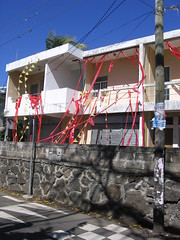
Bunting from the recent Mauritian general election was still visible all over the island during my visit last week. This unusual means of campaigning made some villages look like they were celebrating a fete or a wedding. This house is decked out in the colours of the victorious Alliance Sociale, led by Dr. Navin Ramgoolam. L'AS beat the incumbent MSM/MMM coalition by 38 seats to 22, the fourth consecutive election in which the government has been defeated.

Labels:


create your own visited countries map or vertaling Duits Nederlands